

Community Gardens Program Rules (English)
Brown County Community Gardens
Program Rules
Welcome to the Brown County Community Gardens Program! The following regulations were created to ensure the program follows landowners’ and City of Green Bay ordinances. Thank you for your cooperation.
Brown County Community Garden Rules and Regulations
Quick Links: Cleanup
Contact Information
Brown County Community Gardens Coordinator
2019 Technology Way, Rm 113 STEM Innovation Center Green Bay, WI 54311
Phone: (920) 391-4660
Email: community.gardens@browncountywi.gov
Gardens and Site Leaders
*Bi-lingual Site Leaders or Communicators are always needed! If you are interested in these volunteer positions, please contact the Community Garden Coordinator for more details.
Thank you for helping to ensure the program welcomes everyone.
| Garden | Site Leader |
|---|---|
| 5th St | Mary V |
| 8th St | Anuli S |
| Annunciation | Crystal B |
| Church Rd | Monica P |
| Community Church | John R |
| Four Seasons Park | Justin C |
| Kroc Center | Pete B |
| Lake Largo | Allen P |
| Lions | Alina S |
| MacArthur Heights | Bruce S |
| Maple and Augusta | Jenna M |
| Olde North | Jim V |
| Veterans’ Garden | Melissa W & Wanda K |
Communication
Garden Updates
Gardeners and Co-Gardeners will be notified by email when plots are ready for planting and garden access is available.
Important announcements may be communicated through:
- Text message
- Posted garden signs
- Community Garden Newsletter
- Social Media
Volunteer Opportunities: volunteer opportunities will be shared through the Community Garden newsletter and related emails.
Registration & Plot Assignments
Plot Limits
- Returning gardeners may renew a maximum of three (3) plots per household
- New gardeners may register for only one (1) plot per household during the initial new-gardener registration period
- Select garden sites may be limited to one (1) plot due to available space. Any site-specific plot limitations will be communicated during registration
- After the renewal period, unclaimed plots become available to new gardeners on a first-come, first-served basis
- Plot renewals are limited to three plots per household and are available only to household members or co-gardeners listed on the prior year’s registration
- After new gardener registration closes, remaining garden plots will become available to renewing and new gardeners
Rental Fees & Payments
Price List: go.wisc.edu/pricelist
Rental Fees & Payment
- Garden rental fees are determined by plot size, location, and the costs associated with garden maintenance and upkeep
- Rental fees are reviewed annually and are subject to change
- Both payment and registration form must be received to reserve a plot
Returning Gardeners
Returning gardeners will be given priority for their previous plot when possible; however, payment does not guarantee the same plot. If payment is not received by the renewal deadline, the plot may be reassigned.
New Gardeners
New gardeners will be assigned available plots after payment is received and all registration requirements are completed.
Planting & Garden Opening
Garden Opening
Garden opening dates are determined by weather conditions and the type of garden. Gardeners will be notified by email when plots are ready for planting.
Planting Requirements
- Plants must have a growth period of less than 110 days (annuals only).
- Garden plots must be planted by June 10
- If garden opening dates are delayed, this planting deadline may be adjusted accordingly
- Brown County stakes and plot signs must remain with the plot or be returned to the Community Garden Coordinator at the end of the season. Returning them helps reduce replacement costs
Plot Transfers, Reassignment , Cancellation
- Garden plots may not be sold, transferred, or reassigned
- If you decide not to garden, notify the Community Garden Coordinator at (920) 391-4660 as soon as possible so the plot can be reassigned
- No refunds will be issued for plots reassigned after June 1
Tentative Opening Dates
*Please Note: Straw and mulch deliveries will occur after tilled gardens have opened.
| Garden Type | Expected Opening |
|---|---|
| Tilled Gardens | Late May |
| Raised Bed Gardens | Mid May |
| No-Till Gardens | Mid May |
Gardener Etiquette & Conduct
Respectful Conduct
Gardeners are expected to:
- Treat fellow gardeners, volunteers, Site Leaders, and program staff with courtesy and respect
- Refrain from harassment, discrimination, threatening behavior, intimidation, or any other inappropriate conduct
- Report inappropriate behavior or safety concerns to the Community Garden Coordinator as soon as possible
Garden Access & Plot Boundaries
- Use designated pathways and do not enter another gardener’s plot without permission
- Garden sites are open from sunrise to dusk. Gardeners must leave the property by dusk each day
- Plant only within your assigned plot or raised bed. Plants outside the boundaries may be removed during maintenance
- Be mindful of neighboring gardens when planting tall or spreading crops
Children
- Children are welcome and encouraged to participate with adult supervision
- Please keep children in your family’s plot or designated pathways and off neighboring private property
Sales & Commercial Activity
- The sale of goods, produce, or services is not permitted on garden property without prior authorization
Theft & Vandalism
- Theft, vandalism, or intentional damage to another gardener’s plot, plants, tools, or personal property is strictly prohibited and will result in permanent removal from the Brown County Community Gardens Program
- Gardeners are responsible for securing their tools and equipment. Brown County Community Gardens is not responsible for items that are lost, damaged, or stolen when left unattended
- If you witness or suspect theft, vandalism, or other suspicious activity, please report it immediately by contacting:
- Brown County Non-Emergency Line: (920) 391-7450
- Community Garden Coordinator: (920) 619-9375
Garden Policies
Alcohol, Smoking/Vaping & Tobacco Use
- Alcohol, smoking, vaping, and tobacco products are prohibited on Community Garden property. We appreciate your help in keeping our gardens clean, healthy, and smoke-free
Parking & Vehicle Access
Gardeners must park only in designated parking areas and follow all posted signs and instructions at each garden location.
- Do not drive or park on grass unless authorized by the Community Garden Coordinator or property owner. Use designated parking areas and caution on unpaved roads, especially after rain
- Parking changes or temporary restrictions will be communicated by email and posted signs. During events, gardeners may be directed to alternate parking areas
- Some garden sites may host community events. During events, gardeners may be asked to use alternate parking. Please follow all posted signs and instructions
- The Brown County Community Gardens Program is not responsible for vehicles that become stuck or sustain damage while accessing garden properties
Pets
- Pets are not permitted within Community Gardens borders
- Service animals are welcome as required by law
- Please do not leave pets unattended in vehicles
Restrooms
- Restroom facilities are not available at community garden sites. Please plan accordingly before visiting the garden
- Public urination or defecation is prohibited in accordance with Wisconsin law and the Green Bay Municipal Code (§ 5-1-12: Prohibition of Public Urination, Defecation, and Vomiting)
Garden Maintenance
Garden Neglect & Assistance
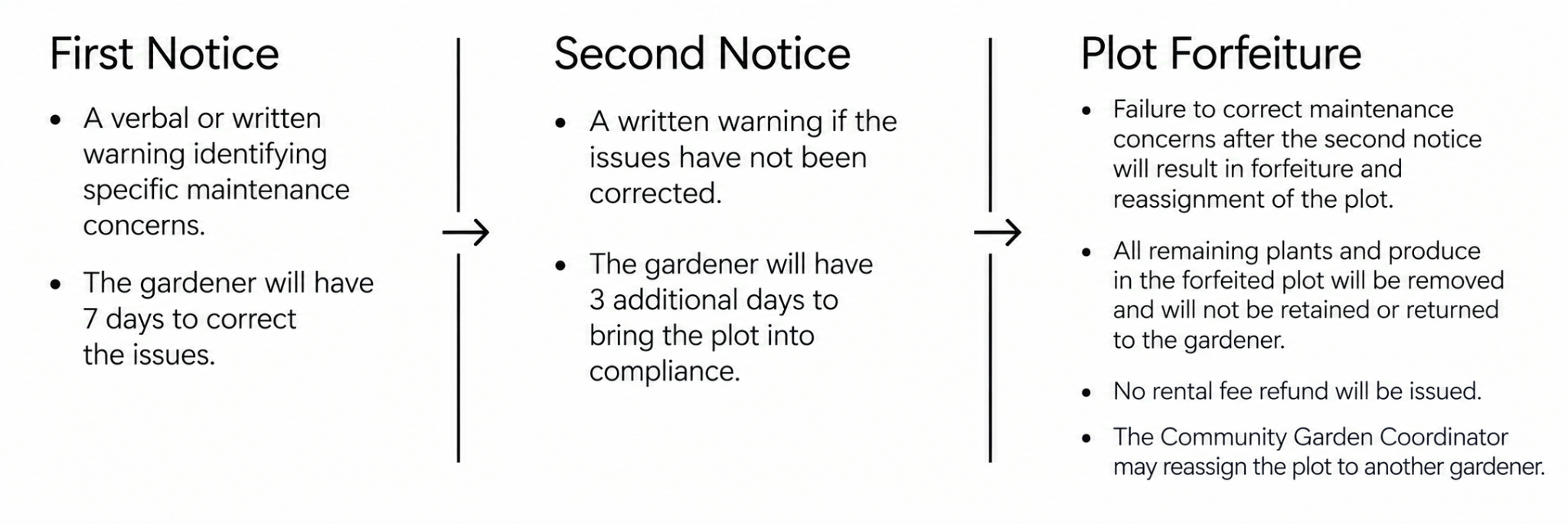
Gardeners who have neglected garden plots and surrounding plots and pathways will be notified they have 7 calendar days to remove weeds.
If a plot is determined to be neglected, the following progressive enforcement process will apply:
Water
- Water is available at all garden locations for watering plants only and is not for drinking
- Turn off all water spigots, hoses, and equipment when you are finished
- Use water responsibly and avoid overwatering whenever possible
- Water may occasionally be unavailable due to maintenance, weather, or other circumstances
- Gardeners are encouraged to plan accordingly and conserve water whenever possible
Waste Disposal
- Water is available at all garden locations for watering plants only and is not for drinking
- Turn off all water spigots, hoses, and equipment when you are finished
- Use water responsibly and avoid overwatering whenever possible
- Water may occasionally be unavailable due to maintenance, weather, or other circumstances
- Gardeners are encouraged to plan accordingly and conserve water whenever possible
Weeds
- Gardens, borders, and adjacent pathways—including areas along and inside/outside fencing—must be maintained at least 80% weed-free
- Weeds must remain under 6 inches in height and in accordance with local ordinance
- Approved weed barriers include straw, leaves, mulch, plain-brown cardboard, woodchips, row cover, or plastic film
- Cover cardboard with soil or mulch to prevent it from blowing away
- Landscape fabric, plastic, rocks, and stakes must be removed at the end of season
Soil & Growing Practices
Fertilizers
Gardeners may use both organic and synthetic fertilizers to improve soil fertility and support healthy plant growth. The pesticide policy is strictly enforced. (See below)
First violation: Written warning. Second violation: Loss of gardening privileges.
Gardeners may use organic and synthetic fertilizers to support healthy plant growth. Synthetic fertilizers containing herbicides are prohibited; when in doubt, contact the Community Garden Coordinator before use.
Acceptable Fertilizers
Organic Fertilizers & Soil Amendments
- Smoking is not allowed anywhere on the garden properties.
- Composted manure
- Green manure
- Fish emulsion fertilizer
- Wood ash (use sparingly)
- Leaves and other decomposed plant material
- Kitchen scraps such as banana peels, coffee grounds, crushed eggshells must be buried
- Fish and meat scraps must be buried at least 12 inches deep
Synthetic Fertilizers
- Espoma Garden Food (10-10-10)
- Other balanced fertilizers that do not contain herbicides
Pesticides
The Brown County Community Gardens Program strictly regulates pesticides to protect gardeners, beneficial insects, wildlife, and the environment. Pesticides are substances used to prevent, destroy, repel, or control pests; if you are unsure whether a product is allowed, contact the Community Garden Coordinator before use.
- Herbicides – control or kill weeds
- Insecticides – control or kill insects
- Fungicides – prevent or control fungal diseases
Safety Use
farms.extension.wisc.edu/forward-farm-safety-toolbox/pesticide-handling-and-application
Always read and follow the manufacturer’s label and application instructions. Apply pesticides only as directed and when necessary. Even approved organic or naturally derived products are not non-toxic and should always be handled and applied safely.
Acceptable Pesticides (Insecticides & Fungicides)
Only select insecticides and fungicides are permitted. Acceptable products include:
- Insecticidal soaps and horticultural oils
- Botanical insecticides (such as neem, pyrethrin, and spinosad)
- Microbial insecticides (such as Bt products, including Dipel®, Thuricide®, and M-One®)
- Mineral insecticides (such as diatomaceous earth)
- Copper soap and copper fungicides
- 70% neem oil
- Actino-Iron®
- Sevin dust or spray
Prohibited Pesticides
- All Herbicides are NOT permitted in any Brown County Community Garden
- Manufactured or inorganic pesticides, including: Round-Up, Malathion, Diazinon, Methoxychlor, Marlate, Spectracide, Rotenone, etc
Stones
- Gravel and small stones should be left in your garden plot. They may become more visible after tilling and can help improve soil drainage and aeration
- Do not place or remove stones in grassy areas, pathways, or common areas. Keep mowing areas free of stones and debris
Tilling
- Seasonal tilling is provided by the program; gardeners may use hand tools and rototillers
- Avoid rototilling wet soil because it can worsen drainage and degrade soil
- Avoid excessive rototilling to prevent soil problems
Garden Clean Up
End-of-Season Cleanup
- Neatly place county stakes and signs near the designated water source unless otherwise instructed, and remove and discard all strings attached to the stakes before returning them
- Remove all trash from your garden plot. Do not leave garbage on-site or store materials under raised beds, near water tanks, or anywhere else within the garden.
- Remove all personal property by the garden closing date, including:
- Fencing
- Trellises
- Decorations
- Signs
- Buckets, barrels, watering cans, and tools
- Tomato cages
- Landscape fabric, plastic, stakes, rocks, and blocks
- Any other personal items
Garden-Specific Cleanup & Deadlines
Cleanup Requirements:
- Cut stalky crops (corn, sunflowers, broccoli, kale, cabbage, etc.) to 1–3 inches above the ground
- Remove all other plants, including roots
- Haul plant material to an approved yard waste site
- Remove all personal fencing and materials
- Place county stakes and signs neatly near the designated water source
Disclaimers
Extension Brown County, Brown County, the City of Green Bay, and partners are not responsible for mishaps, injuries, illnesses, stolen food, tools, materials, or other personal property, vandalism, or other harm caused by people, animals, or weather. Plot sizes are approximate and may vary. Garden opening is at the discretion of the Community Garden Coordinator, and plot assignments are non-transferable without prior Coordinator approval.